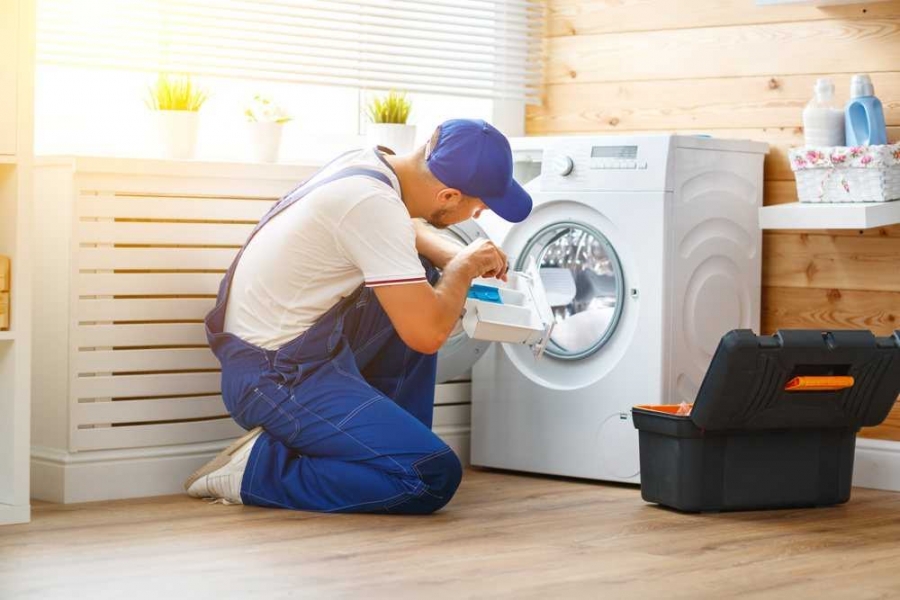
Washer repairs are the most predictable prices on this site. Across 4,763 completed washer repairs the median is $370, and every common component lands between $341 and $450. Unlike a refrigerator, there is no single repair that doubles the bill, which means the diagnosis rarely changes the decision.
What each washer repair costs
Washers are our second-largest category at 30.7 percent of all repairs, just behind refrigerators. The component table is unusually tight, and that tightness is the useful fact.
| Repair | Typical total | Based on |
|---|
| Drive belt | $341 | 74 repairs |
| Door lock or lid switch | $351 | 143 repairs |
| Water inlet valve | $362 | 137 repairs |
| Shock absorbers or suspension | $367 | 195 repairs |
| Tub bearing | $380 | 11 repairs |
| Drain pump | $381 | 213 repairs |
| Drive motor | $387 | 81 repairs |
| Motor control board | $436 | 163 repairs |
| Front-load door boot seal | $450 | 49 repairs |
Median full ticket: part, labour and the service call together. Overall washer median $370, middle range $310 to $445. A diagnostic visit with no part replaced is $99, credited toward the repair if you approve it. Stacked washer-dryer units are $150 to diagnose because both machines have to come apart.
The cheapest repair on that list and the most expensive are $109 apart. A drive belt costs a few dollars as a part and a control board costs a hundred and fifty, yet the finished bills are close, because what you are paying for is a technician at your address for an hour or two. That is why our quote is always the finished job, part, labour and visit together, never a part price on its own.
What it costs by symptom
Most people describe a washer problem by what it does, not by which component failed. Here is the same data arranged that way, from the complaint we actually receive.
| Complaint | Typical total | Based on |
|---|
| Leaking | $354 | 482 repairs |
| Will not spin | $362 | 384 repairs |
| Noise or shaking | $372 | 584 repairs |
| Will not start | $376 | 103 repairs |
| Will not drain | $377 | 508 repairs |
| Error code on the display | $385 | 492 repairs |
Every complaint sits within $31 of every other. A washer fault is a $350 to $390 event almost regardless of what the machine is doing.
That flatness is the practical takeaway. On a refrigerator the diagnosis matters enormously, because the answer is either a $386 sensor or a $956 compressor. On a washer it barely matters at all for planning purposes. If your washer has failed and it is not fifteen years old, the repair is almost certainly worth doing, and you can decide that before anyone opens it.
Matching the symptom to the likely cause
- Water standing in the drum at the end of the cycle. Drain pump most often, or a blocked filter and drain hose. The technician checks the filter first, behind a panel at the front bottom on most front-loaders, before testing the pump.
- Drum fills and drains but never spins. Drive belt, door lock or lid switch. Many machines refuse to spin at all if the lock does not register as closed, which is a $351 repair rather than anything structural.
- Violent shaking, machine walking across the floor. Suspension or shock absorbers, particularly on front-loaders past five years. Tell us whether the machine is level and whether the shipping bolts were removed at installation.
- Water on the floor. Front-loaders usually the door boot seal, top-loaders usually a hose or the inlet valve. The boot seal is the most expensive routine washer repair at $450 and also the most visible: tell us if you can see a tear or trapped debris in it.
- Dead panel, nothing responds. The technician confirms power at the outlet and the breaker first. Past that, door lock or the control board.
- Error code on the display. Worth writing down before you call, because the code narrows the diagnosis and can shorten the visit. Median $385.
- Musty smell. Usually moisture and residue trapped in the gasket and detergent drawer. The technician checks the drain path and the seal for standing water that keeps it coming back, and the routine that keeps it away is on how to deep clean a front load washer.
Three things worth telling us when you book. Whether the machine stopped mid-spin with an error, because an unbalanced load does that on most modern machines and looks exactly like a fault. Whether there is standing water, because a drain filter clogged with lint and coins produces the same symptom as a failed pump, and the technician checks the filter before the pump. And whether the machine shakes, because one that was never levelled after delivery will shake regardless of how healthy the suspension is. More on the balance question at
washing machine out of balance.
Front-load or top-load changes what fails
The two designs fail differently, and it shows in our workload. Front-loaders bring us door boot seals, drain pump blockages and suspension wear, plus the moisture and odour complaints that are maintenance rather than repair. Top-loaders bring lid switches, drive belts and agitator problems.
Our data shows what fails on each design rather than which design is more reliable, because it reflects what is installed in our customers’ homes. The design comparison is covered on front load versus top load washers, and the agitator question specifically on washing machine agitator types and repair costs.
How a washer visit works
- You book online or by phone and choose a window.
- The technician runs the machine through the failing part of the cycle, checks the drain path, the door lock, belt and suspension, and reads any stored error codes.
- You get the full price before work starts, part and labour together.
- You approve the work or keep the diagnosis. If you keep the diagnosis, the $99 diagnostic is all you pay.
- Approved work carries a 90-day parts and labour warranty.
Washer repairs are among our cheapest, and you get the repair price and the age of the machine side by side before any work starts, so the repair-or-replace decision is yours to make with real numbers.
Which washer brands we see most
| Brand | Share of branded washer calls |
|---|
| Whirlpool | 21.6 percent |
| GE | 19.7 percent |
| Samsung | 19.2 percent |
| Maytag | 11.0 percent |
| LG | 8.4 percent |
Based on 8,320 branded washer calls. This measures how much of the installed base we service, not failure rate per unit sold. See most reliable appliance brands for the reliability discussion.
One correction worth making, because it comes up in quotes people bring us from elsewhere. Tub bearing failure is often presented as a common Samsung washer problem. In our data it is not: across the whole workload a bearing replacement happens roughly once in every 718 washer repairs. The symptom that gets attributed to bearings, loud noise on the spin cycle, is far more often suspension, and that is a $367 job rather than a teardown.
Washer repairs peak in early summer
Washer demand rises through spring and peaks in June at 10.3 percent of the year’s washer calls, against a February floor of 6.8 percent. The curve is gentler than the one for dryers or refrigerators, but it is the same shape: laundry volume rises with warm weather and household activity, and machines that were coping stop coping.
If your washer is showing early symptoms in April or May, that is the cheapest time to have it looked at, both because slots are easier and because a suspension or a belt caught early does not become a motor failure.
What we repair
Front-load, top-load, high-efficiency, agitator and impeller machines, stacked washer-dryer units, and light commercial laundry. All major manufacturers. Stacked and commercial units carry the $150 diagnostic because of the additional access work.
Commercial and multi-unit laundry
We service laundry rooms in apartment buildings, condo associations, laundromats and small hospitality operations alongside domestic machines. The economics there are different in a way worth stating: a machine out of service is lost revenue every day it sits, so response time matters more than the repair price, and a stocked common part beats a cheaper quote that waits a week for delivery.
Commercial machines also fail differently. Duty cycle is the driver rather than age, so drain pumps, door locks and suspension come round on a schedule rather than at random, and a building with six identical machines will usually see the same fault walk through all six within a year. Where that pattern shows up we will say so, because replacing a wear part on the other five during one visit is cheaper than five separate call-outs.
Hard water shortens washer life
Much of our service area runs hard water, and it does measurable damage to washers over time: scale on the heating element in machines that have one, restricted inlet valves, and residue that keeps the door seal damp. It does not cause a dramatic failure, it just brings the ordinary ones forward by a year or two.
The cheap countermeasures are the boring ones. Run a hot cycle with a descaling product every few months in a hard-water area, leave the door ajar between loads on a front-loader, and do not overdose detergent, since excess residue is what feeds both the odour and the valve restriction. None of it replaces a repair when a part fails, but it keeps the ordinary faults from arriving early.
Discounts
$30 OFFVeteransEvery repair
$30 OFFSeniorsEvery repair
$20 OFFNew customersFirst service call
The $179 annual membership covers five free diagnostics a year, priority scheduling with a 24 to 48 hour response, $30 off labour on every repair and an extended warranty on Bozmanfix work.
Frequently asked questions
How much does washer repair cost?
The median washer repair where a part is replaced is $370, with most jobs between $310 and $445 including parts, labour and the service call. Individual components run from $341 for a drive belt to $450 for a front-load door boot seal. A diagnostic visit with no part replaced is $99, and stacked washer-dryer units are $150 to diagnose.
My washer will not drain. What is wrong?
Most often the drain pump, at a $381 median, or a blocked filter and drain hose, which the technician checks first. The filter is behind a small panel at the front bottom on most front-loaders. Across 508 repairs for this complaint the median was $377.
Why does my washer shake and move across the floor?
Usually the suspension or shock absorbers, a $367 repair, particularly on front-loaders past five years. When you book, mention whether the machine is level and whether the shipping bolts were removed when it was installed, because both produce the same symptom and the technician checks them first.
Is a tub bearing failure common on Samsung washers?
No. In our workload a tub bearing replacement occurs roughly once in every 718 washer repairs. Loud noise on the spin cycle, which is often attributed to bearings, is far more commonly the suspension at a $367 median rather than a bearing teardown.
Is it worth repairing a washing machine?
Usually yes, and the reason is that washer repairs are unusually flat in price. Every common complaint, from leaking to a dead control panel, sits between $354 and $385. There is no washer equivalent of a refrigerator compressor that doubles the bill, so if the machine is not near the end of its life the repair is almost always the cheaper path.
My washer will not spin. Is that a big repair?
Rarely. The most common causes are the drive belt or the door lock and lid switch, at $341 and $351. Many machines refuse to spin entirely if the door lock does not register as closed, so a symptom that looks structural is often a switch. Across 384 repairs for this complaint the median was $362.
Why does my front-loader smell musty?
Most often moisture and detergent residue trapped in the door gasket and the drawer, and the technician checks the drain path and the seal for standing water that keeps the smell coming back. Day to day it is kept away with maintenance: leave the door open between washes, wipe the gasket, and run a hot clean cycle monthly.